Mastering the Continuous Line: A Guide to Minimalist Wildlife Illustration
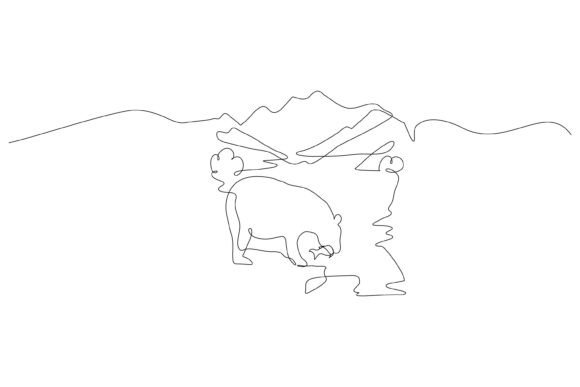
In the vast world of digital art and graphic design, few styles capture the essence of simplicity and elegance quite like the continuous line design. This artistic technique, where an image is created using a single unbroken stroke, has surged in popularity across various industries, from modern web design to home decor. Today, we will explore this fascinating concept through a specific and evocative subject: a polar bear looking for food, and more specifically, a view of a polar bear looking for food in the river. By understanding how these complex natural scenes are distilled into a single flowing line, you will gain a deeper appreciation for the intersection of nature, art, and technology.
What is Continuous Line Design?
At its core, continuous line drawing is exactly what it sounds like. The artist places their pen (or stylus) on the canvas and does not lift it until the artwork is complete. There are no breaks, no lifting of the hand, and often, the end of the line connects back to the beginning to create a closed loop. While this may sound like a simple party trick, it requires a profound understanding of form, negative space, and composition.
When applied to wildlife, such as our polar bear, the challenge increases exponentially. The artist must convey the bulk of the animal, the texture of its fur, the movement of water, and the intent of the hunt without relying on shading or color blocks. Instead, they rely on the density of the lines and the curvature of the stroke to suggest depth and volume. This style fits perfectly into modern life because it is clean, scalable, and visually soothing amidst the chaos of high-resolution, hyper-realistic media.
The Significance of the Subject: The Hunting Polar Bear
Why choose a polar bear searching for sustenance? This subject matter carries significant weight both ecologically and artistically. The polar bear is an apex predator,象征着 strength and survival in one of Earth's harshest environments. Depicting a polar bear looking for food tells a story of necessity and instinct. When we narrow this down to a view of a polar bear looking for food in the river, we introduce dynamic elements: the flow of water, the reflection of light, and the tension of the hunt.
In a continuous line format, this scene becomes a meditation on focus. The single line mimics the bear's singular focus on its prey. It strips away the distracting details of the Arctic landscape—the snow, the ice chunks, the sky—and forces the viewer to concentrate solely on the relationship between the animal and the river. This reductionist approach helps readers and viewers build a broader understanding of the subject by removing noise and highlighting the essential forms.
Practical Relevance in Modern Design and Business
You might wonder how a drawing of a bear relates to your daily work or business endeavors. The answer lies in versatility. Continuous line illustrations are incredibly popular in branding, user interface (UI) design, and educational materials. Here is why this specific type of asset—available in formats like EPS, SVG, and JPG—is so valuable:
- Scalability: Because these designs are often vector-based (SVG and EPS), they can be resized from a tiny favicon on a website to a massive billboard without losing quality. This is crucial for businesses that need consistent branding across different platforms.
- Loading Speed: SVG files are code-based and typically much smaller in file size than heavy photographic images. Using a continuous line polar bear icon on a webpage about conservation can improve site speed, which is a key factor in SEO and user experience.
- Aesthetic Flexibility: The "decorative elements drawn on a white background" style mentioned in many design briefs offers a clean slate. It allows designers to overlay text, change colors programmatically, or integrate the image into complex layouts without clashing backgrounds.
Understanding File Formats: EPS, SVG, and JPG
To truly utilize these artistic assets, one must understand the tools of the trade. When you purchase or download a continuous line design, you will often encounter three specific file types. Each serves a distinct purpose in the ecosystem of digital creativity.
- EPS (Encapsulated PostScript): This is the industry standard for print. If you intend to put your polar bear illustration on a t-shirt, a brochure, or a large banner, the EPS file is your go-to. It preserves the vector data, ensuring that professional printers can scale the image to any dimension required.
- SVG (Scalable Vector Graphics): This is the king of the web. SVGs are XML-based, meaning they can be manipulated with CSS and JavaScript. For a web developer, an SVG of a polar bear allows for interactive animations—perhaps making the line draw itself upon page load or changing color when a user hovers over it.
- JPG (Joint Photographic Experts Group): While vectors are superior for editing, JPGs are universal. Everyone can open a JPG. This format is best for social media posts, email newsletters, or quick previews where vector editing software is not available. However, remember that JPGs are raster images; if you zoom in too far, you will see pixels.
Common Misunderstandings and Clarifications
Despite the growing popularity of this style, there are several misconceptions that often confuse beginners and clients alike.
Misconception 1: It is easy to create.
Many assume that because the image looks simple, it is quick to produce. In reality, planning a continuous line drawing of a complex scene like a polar bear in a river requires extensive sketching. The artist must plan the path of the line meticulously to ensure it doesn't cross itself in awkward ways that ruin the illusion of form. One wrong move, and the entire piece may need to be restarted.
Misconception 2: White background means it cannot be changed.
When a product description says "decorative elements drawn on a white background," it often refers to the preview image (usually the JPG). However, if you have the vector files (EPS/SVG), the background is typically transparent or easily removable. You are not stuck with white; you can place the bear on a blue background to represent the ocean or a green one for an environmental campaign.
Misconception 3: It lacks detail.
Critics sometimes argue that minimalism sacrifices detail. However, in the context of a polar bear hunting, the lack of detail is the point. It forces the brain to fill in the gaps, creating a more engaging cognitive experience for the viewer. The suggestion of ripples in the river through a wavy line is often more powerful than a photorealistic rendering of water.
How This Fits Into Education and Creativity
Beyond commercial use, continuous line art is a fantastic tool for education. Teachers can use these images to teach students about geometry, biology, and art history simultaneously. For instance, a lesson on Arctic ecosystems could feature a continuous line polar bear looking for food as a coloring activity or a tracing exercise to improve fine motor skills.
Furthermore, for aspiring artists, studying these designs offers a masterclass in observation. To draw a bear in a single line, you must observe the animal deeply. Where does the shoulder connect to the neck? How does the head tilt when scanning the water? This practice enhances observational skills that are transferable to photography, writing, and even scientific research.
Conclusion: The Power of Simplicity
The journey from a raw concept—a view of a polar bear looking for food in the river—to a polished digital asset in EPS, SVG, and JPG formats is a testament to the power of human creativity. Continuous line design bridges the gap between the chaotic beauty of nature and the structured needs of modern design. It reminds us that sometimes, less is indeed more. Whether you are a graphic designer looking for your next project, a business owner wanting to refresh your brand, or simply an art enthusiast, understanding the depth behind these simple lines enriches your perspective.
By embracing this style, we not only celebrate the majesty of wildlife but also adopt a mindset of efficiency and clarity. In a world cluttered with information, the single, unbroken line stands out as a beacon of focus, guiding our eyes and our minds toward what truly matters. So, the next time you see a minimalist drawing of a bear, take a moment to trace the path of that line in your mind, and appreciate the intricate balance of art and nature it represents.